Tuesday, October 13, 2026


Tuesday, October 13, 2026
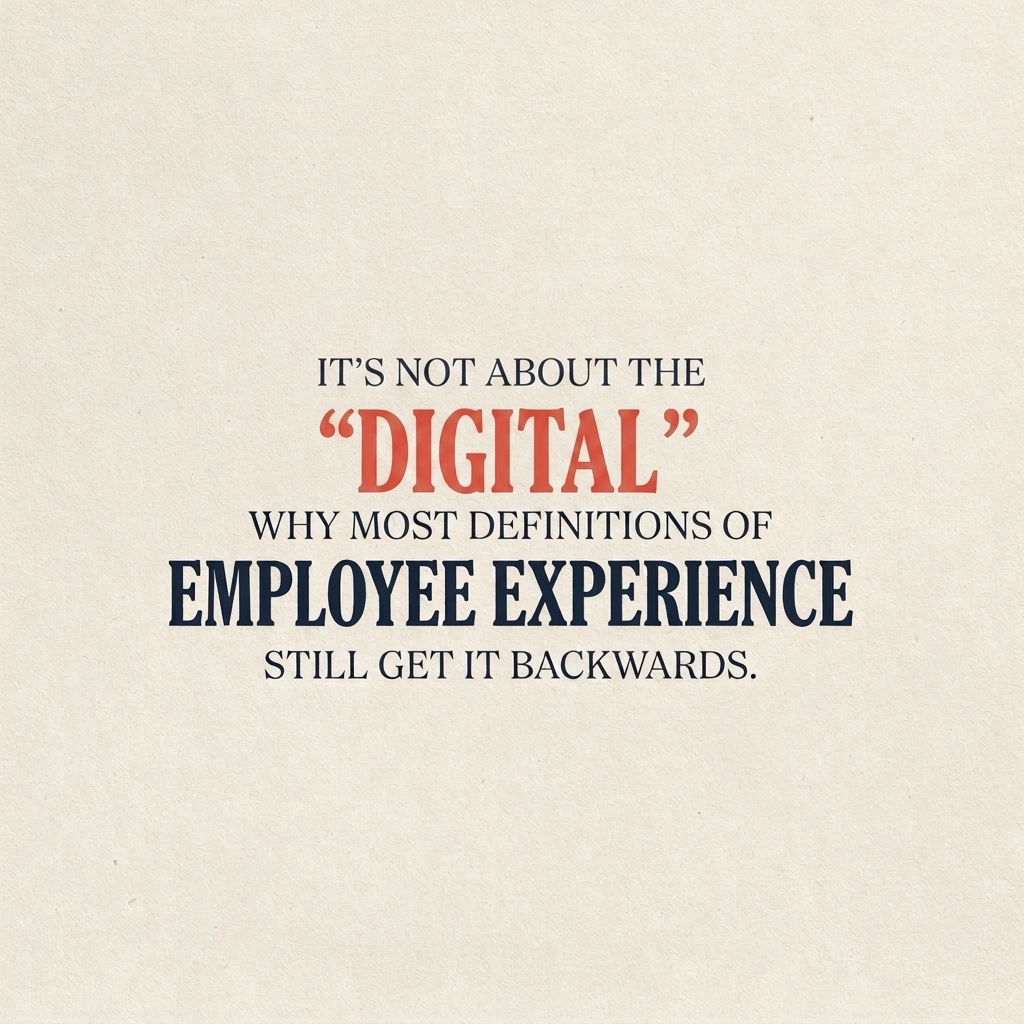
Every few years, the digital workplace industry produces a new acronym to describe the same unresolved question: does the technology actually serve the person using it. The current answer is DEX – digital employee experience. According to Christiaan Lustig, co-author of the world’s first book on the subject, most organizations are still defining it in a way that leaves the employee out.
Lustig, an independent digital workplace consultant based in the Netherlands, joined Jarbas Horst and David Bowman of Fresh Intranet on the Fresh Perspectives podcast to explain why. In 2018, Step Two founder James Robertson coined the definition that the industry has run with ever since: DEX is the sum total of all digital interactions in a work environment. It is accurate. It is also, in Lustig’s assessment, a little flat – a little dry.
When Lustig and co-author Tabhita Minten wrote their 2021 book, they added the clause they felt was missing: great digital employee experience is the sum of all digital interactions in a work environment where the needs and expectations of employees come first.
That single clause is the whole argument.
The employee, not the interface
Organizations hire people to do a job and pay them to do it. Lustig’s point is that DEX work should start there, not with the software. It is not primarily about the technology, the hardware, or even the “experience” in an abstract sense – it is about the person on the other end of the screen, and whether the digital tools around them remove friction or add to it.
That distinction matters most at the extremes. In a ten-person business, the digital workplace might just be Outlook, Word, and WhatsApp – and that is entirely sufficient. The larger an organization grows, the more tools get purchased to solve smaller problems, and the wider the resulting sprawl becomes. DEX, in Lustig’s framing, is not a fixed standard to hit. It is a lens that becomes more necessary as an organization’s tool count grows, and one that should flex to the context it is applied in.
Vertical silos, and the one horizontal bridge
Most applications inside an organization are what Lustig calls vertical: HR systems, finance systems, facilities systems, each belonging to a silo, each solving that silo’s problem. Few tools function as horizontal platforms – built to bridge the gaps between those silos rather than deepen them.
The intranet, in Lustig’s view, is one of the only tools built for that horizontal role. It will not command the vertical tools, and it should not try to. But it can help build the connective tissue between departments working toward the same underlying goal: making work easier for the people actually doing it. That, he argues, is the intranet’s enduring value proposition, even as Microsoft Teams and other platforms have repeatedly been crowned its replacement.
Adoption problems are diagnostic, not incidental\
Ask Lustig about handling resistance to new tools, and he reframes the question. If an organization has to spend heavily on adoption campaigns to get a tool used, that is not a communication failure to be solved with more training. It is a signal that the wrong tool was implemented, or the right tool was implemented the wrong way.
His starting method, before any technology decision, is the same on every project: spend fifteen minutes each with ten or twelve people doing the actual work, and find out what is going right and what is going wrong. Most people, he notes, are trying to do a good job – the task is finding out what is standing in their way. The second step is turning those qualitative conversations into something tangible: personas, task identification, anything that makes the insight concrete enough to design against.
AI as a third interface, not a shortcut
Lustig places today’s AI moment inside a longer arc of how people interact with digital tools: first the command line, then the mouse and graphical interface, and now conversation. He is skeptical that conversational AI is the best interface for everything – point-and-click will often remain faster – but he expects it to become one of three modes, alongside search and navigation, that any horizontal platform will need to support.
He also raises a less comfortable implication. Rolling out an AI tool against an organization’s existing document store does not just surface answers – it surfaces exactly what has been sitting there unused and unmaintained for years. Poor content management, previously invisible, becomes visible the moment AI starts drawing on it. Robertson, Minten, and Lustig’s original argument – that DEX ownership can’t sit in a single silo – applies directly here: if AI access isn’t managed as a shared, horizontal concern, organizations end up with several siloed, vertical AI implementations instead of one coherent one.
A name for the ownership gap
Lustig points to a concept Forrester introduced under the name Digital Employee Experience Operations, or DEXOps: the idea that DEX ownership needs to be a shared function spanning IT, communications, HR, and facilities, working from a common goal rather than separate mandates. It is, he notes, close to the “association of owners” model he and Minten proposed in their own book years earlier. Whether the label that sticks is DEXOps or something else, Lustig sees the direction as the same: DEX only improves when the departments responsible for it stop treating it as someone else’s problem.
Where to start
For organizations without a formal DEX practice, Lustig’s advice is deliberately unglamorous: talk to people first. Understand what is getting in the way of their work before reaching for a new platform. It will not fix everything – but it is, in his experience, the step that most consistently gets skipped, and the one every other improvement depends on.
+++
This article is adapted from a conversation with Christiaan Lustig on Fresh Intranet’s Fresh Perspectives podcast, hosted by Jarbas Horst and David Bowman.

© 2026 Stratpair Ltd., trading as Strategic. Registered in Ireland: 747736


