Monday, December 01, 2025


Monday, December 01, 2025
Mike Klein:
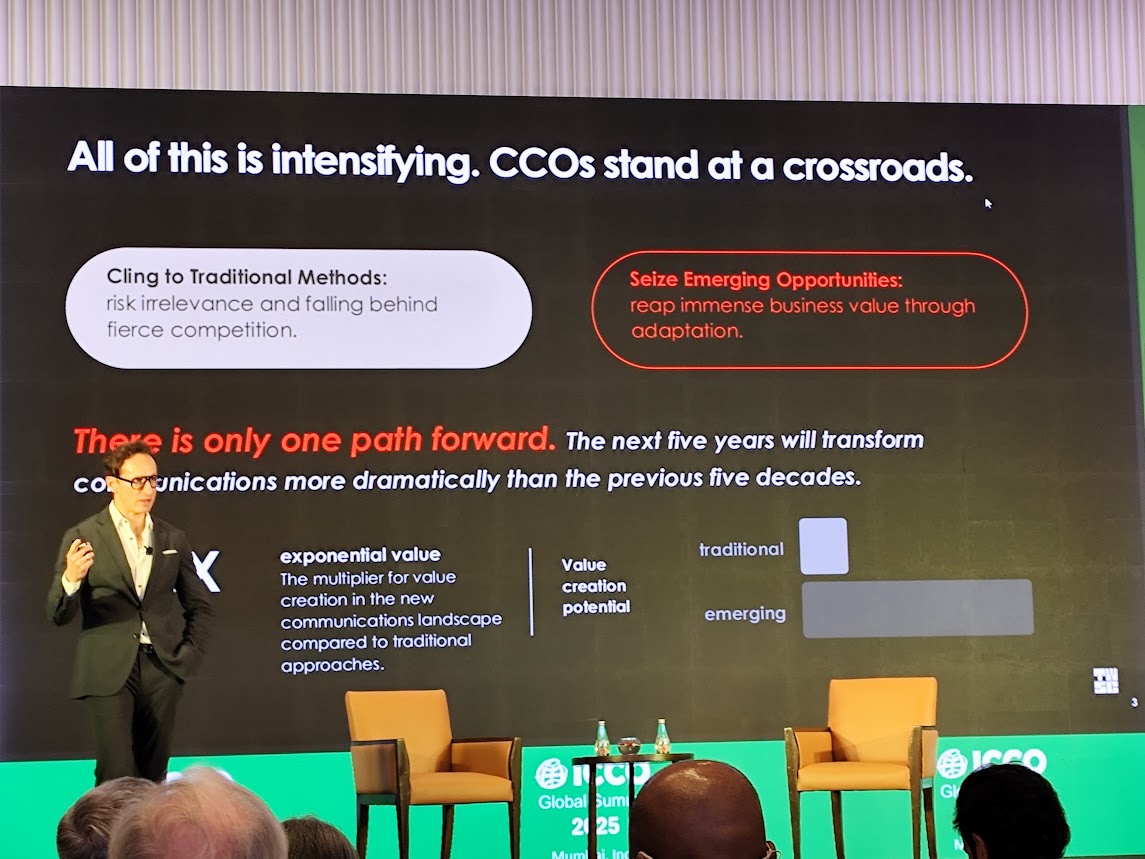
Day One of the ICCO Global Summit in Mumbai offered a snapshot of things that are top of mind for top global communication and PR agency leaders, and indeed, some which are keeping them awake at night.
Certain themes reflected consensus. Others sparked productive disagreement. And one critical dimension—arguably the most critical—barely registered.
On strategic silence: Day One delivered clarity on a fundamental shift in corporate communications towards what participants consistently phrased as “strategic silence.”.
Some numbers: 21% of CCOs now expect their companies to comment on societal issues. Eighty percent are dialing down DEI communications. This isn’t a function of simple hesitation—it’s strategic calculation.
The consensus: everything can be misconstrued and weaponized. The general response: shift pragmatically by dialing down the megaphone, and ramp up precision engagement with stakeholders who matter to your business.
On measurement: The “so what and now what” framework shared by AMEC’s Johna Burke crystallized what too many miss. Measurement isn’t about demonstrating what you did—it’s about demonstrating value tied to business outcomes. The shift from proving activity to proving impact isn’t theoretical anymore. It’s survival.
On geopolitics as business function: When multilateral institutions lose authority and bilateral relationships become transactional, companies need their own diplomatic strategies and need to think of themselves as diplomatic actors. Corporate affairs—as a discipline that integrates traditional comms with government relations and geopolitical analysis—isn’t aspirational anymore. It’s increasingly seen and approached as an operational necessity.
On trust through consistency: The Indian “coconut tree” metaphor for trust hit harder than typical trust discourse. Trust grows slowly like a coconut tree, falls instantly like a coconut. Deep pockets and persistence—staying true to your niche even when environments turn hostile—matter more than messaging pivots. Founder PR emerges not as ego but as strategy, because audiences want to attach truth to a person rather than a brand.
One element of the conference was the level of candor – which provided some space for disagreement and the raising of questions with no clear answers:
On courage and creativity in fractious times: When freedom of expression contracts and polarization intensifies, how do brands maintain creative edge? The normative view—boldness when things aren’t going well, not just when conditions are normal—is appreciated but not always acted on. The harder question is whether consultancies have business models to support client courage when courage gets expensive.
On the AI skills gap: The “humanist data scientist” concept identifies the right unicorn—someone who can interpret big data and translate it into communication strategy.
But how do you build unicorns? When I asked Weber Shandwick CEO Jim O’Leary in the plenary what talent the industry needs and why that talent should choose it, the answer pointed to the challenge: we know what we need, but we’re far less clear on why we deserve to get it.
On collective action: Using industry associations to take positions individual companies won’t risk makes strategic sense. But does it work? The US Chamber of Commerce challenging H-1B visa surcharges is the test case.
Rod Cartwright’s presentation on crisis and risk—synthesizing 11 major global reports covering 840 pages—emerged as the central discussion of the day, pulling the other conversations about trends, priorities and practices into its vortex .
Rather than offering reassurance, he leaned into discomfort: we live in a world where Murphy’s Law has become structural, where “permacrisis” isn’t hyperbole but baseline.
The ensuing panel discussion didn’t shy from hard truths about how organizations navigate this environment. What struck me was the candor—particularly from Indian and Asian practitioners—about how consultancies actually work, how clients actually decide, and how aspiration-versus-practice gaps shape everything.
Insights from Indian practitioners suggest something worth watching: India may be advancing beyond much of the world in communication practice, not just catching up.
The “jugaad” philosophy came up repeatedly and controversially—dismissed by some as corner-cutting, defended as design thinking adapted to constraint.
But a new conversation emerged – that about how. Indian communicators are demonstrating aplomb and agility in situations of complexity, skills well-honed in a country with more than 400 languages and ethnic, demographic and cultural complexities on a scale unknown in the US and Europe. Indian communication pros solve for multiple audiences across radically different contexts simultaneously, operating where digital acceleration meets infrastructure gaps, where global standards collide with hyperlocal nuances.
One panelist described cervical cancer awareness challenges where intimate health exams remain culturally fraught, illustrating communications environments where every campaign navigates complexity that would paralyze decision-making elsewhere. Another discussed building trust through consistency “in your niche”—market maturity that belies emerging market stereotypes.
Most tellingly, the measurement discussion felt grounded in business outcomes, not vanity metrics. The “so what and now what” framework got immediate recognition, suggesting Indian practitioners may have moved past debates still consuming conference time elsewhere.
One dimension went almost entirely undiscussed: internal communication and employee value proposition. In sessions invoking organizational resilience, this absence stands out.
When employees were mentioned, they appeared defensively—avoiding mutiny, keeping people informed. Missing was recognition that employees are the primary external communication channel in most organizations. Every employee is a media outlet shaping reputation in their networks and communities – and one that operates autonomously at that..
When everything external is contested and politicized, internal alignment becomes the foundation for external credibility. But it was conspicuously missing from the #ICCOGlobalSummit conversation.
What Day 1 did deliver was substantive analysis on navigating external complexity, strong insights from Indian practitioners on operating in multiple contexts, and Rod Cartwright’s unflinching assessment of risk in the permacrisis era. The candor throughout—characteristic of agency professionals talking amongst themselves—made this first agency-focused conference I’ve attended notably valuable.
The thing that ‘s already clear is that conversations about resilience and effectiveness are happening here with more sophistication than the industry often credits itself for—and that Indian communicators may be leading rather than following in figuring out what comes next.
+++
Mike Klein is Editor-in-Chief of Strategic, and also has a consulting practice focused on internal communication in times of change.
Written by: Editor
© 2025 Stratpair Ltd., trading as Strategic. Registered in Ireland: 747736