Monday, December 01, 2025


Monday, December 01, 2025
Mike Klein and Ambuj Dixit:
As AI reshapes the future of work globally, India sits at a unique intersection—home to hundreds of Global Capability Centers (GCCs), a rapidly growing domestic corporate sector, and cultural patterns that both complement and challenge Western business models. Between November and December 2025, we’re embarking on a collaborative research journey to understand how Indian organizations can navigate “The Big Shift”—not by importing Western solutions, but by building on Indian strengths.
This article shares the preliminary patterns we’re exploring and the questions we’re bringing to our workshops and discussions in:
Pune (17-18 November)
Mumbai (19-30 November)
Delhi/Gurgaon (1-3 December)
Hyderabad (4-5 December)
and Bangalore (8-10 December) .
Mike’s perspective:
“I’ve spent the past months speaking with cross-cultural experts, practitioners managing India-based teams from the US, and communications professionals working across the India-West divide. What’s striking is that everyone circles around the same underlying trends—the collision of traditional ways of working with new technological capabilities, generational shifts, and global pressures. But I’m seeing these from the outside, and there’s context I’m missing.”
Ambuj’s perspective:
“The world is changing fast, and we are perhaps at the cusp of an unprecedented SHIFT. Indian organisations will go global and the foreign MNCs will shift their focus on the region in a different manner. No one has all the answers and perhaps not suppose to have. All sides have a lot to learn from each other to ride the shift successfully.
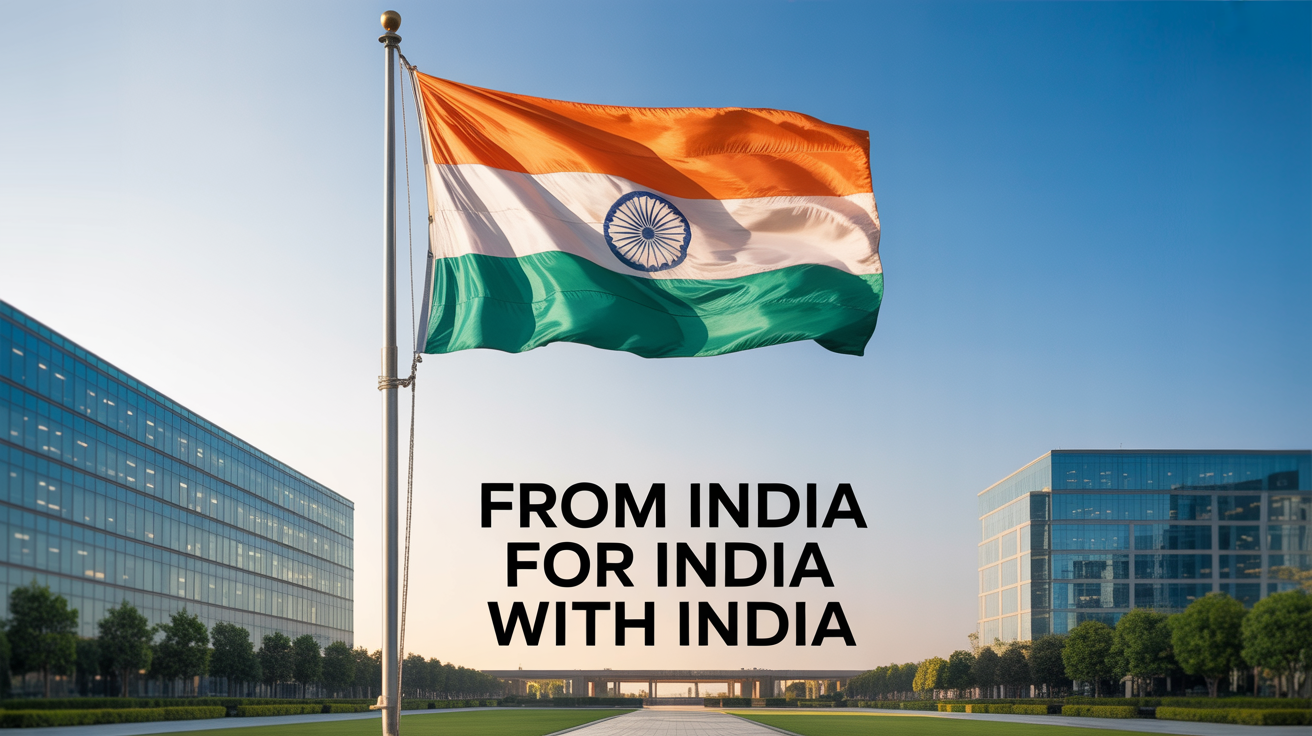
Thoughtcom, which brings almost 2 decades experience in Internal Communications and Employee Engagement, is convinced that collaboration is the need of the hour more than ever before. Experts need to collaborate so that the best of practices, mindsets, values, of both East and West can be aligned to the benefit of all. Hence, the need for From India, To India, With India. Let the Internal Communications community be the biggest enablers of the shift.”
Together, we represent an unusual combination: international perspective meeting local expertise, external observation meeting internal understanding, Western frameworks meeting Indian reality. Our goal isn’t to critique Indian business culture, but to help Indian organizations leverage their unique strengths in an AI-accelerated world.
Through Mike’s exploratory conversations, several recurring themes have emerged—patterns that need validation, challenge, and deeper understanding from Indian business leaders:
What we’re hearing: Indian business culture operates more on “seek permission” than “ask forgiveness,” driving decisions upward through hierarchies. Western managers sometimes find this frustrating when they expect speed, but several experts suggested this isn’t simply about hierarchy—it might reflect confidence dynamics, accountability patterns, or economic realities in a highly competitive job market.
What we need to understand:
What we’re hearing: There’s a sharp distinction between organizations that treat India-based teams as genuine extensions (full integration in town halls, direct stakeholder relationships, two-way knowledge transfer) versus those that treat them transactionally. The former work better, but there appears to be a minimum scale threshold (12+ people) for teams to develop contextual knowledge and strategic capability.
What we need to understand:
What we’re hearing: Indian business communication tends to be more indirect, relationship-first, and that regional differences matter enormously—north more assertive, south more hierarchy-respecting, Mumbai cosmopolitan, Bangalore mixed. Two-way communication isn’t culturally ingrained; even with anonymous question channels, the same handful of people typically participate. Young people want to speak up but lack the cultural training; managers don’t necessarily know how to invite it.
What we need to understand:
During our workshops in [Pune], [Mumbai], [Delhi/Gurgaon], and [Bangalore], we’ll explore whether and how these regional differences show up in practice.
What we’re hearing: Internal communications in Indian companies is often seen as less strategic than external communications—unclear ROI, uncertain retention objectives, no clear business case. One person wondered aloud: “Do we really want to retain people? Or churn every three years for fresh thinking?”
What we’re exploring: How do we develop metrics and practices that allow internal communication to be measured on impact on business performance and effective decision-making rather than clicks, engagement scores, and town-hall participation? This feels like a core part of what we could build together.
What we’re hearing: Jugaad—resourcefulness, improvisation, “making anything happen but not necessarily in the way an outsider would expect”—is a distinctive Indian strength. But can this cultural capability bridge traditional structures with AI-accelerated processes? Or does AI threaten to eliminate the very spaces where jugaad operates?
What we need to understand:
Across these patterns, we’re seeing several recurring tensions:
The cultural-structural bind: The very attributes that might create bottlenecks (hierarchy, relationship-building, indirect communication) might also prevent commodification and preserve human value. How do we streamline and accelerate work in ways that get the most value out of human involvement—making human contribution a differentiator rather than a complicator?
The technology-culture mismatch: AI encodes Western patterns—explicit, direct, transactional communication. Adoption seems to require either adapting technology to Indian culture or adapting culture to technology. But as the Peter Drucker saying goes, “culture eats strategy for breakfast”, and technology adoption is no exception.
The measurement problem: GCCs measured on cost and speed optimize for cost and speed, making them vulnerable to AI displacement. But shifting to innovation and judgment metrics requires parent organizations to reconceptualize the relationship. How do we make that case?
The generational collision: Young people want autonomy; established professionals work intensively and expect the same. The cultural training to question doesn’t exist, but desire for it is growing. How does AI accelerate or complicate this transition?
We’re convinced there’s something powerful in collaborative research that honors both perspectives. The patterns we’re seeing suggest a massive shift coming—not just for GCCs, but for Indian companies expanding abroad, and eventually for global businesses everywhere as AI reshapes work.
What makes this collaboration valuable:
Mike brings: International perspective on internal communication best practices, frameworks for organizational change, experience with large international organizations, and fresh eyes that can help translate between cultural contexts.
Ambuj (Thoughtcom) brings: Deep understanding of Indian business culture, regional variations,what actually works on the ground, insights on future ready workforce, knowledge of Indian companies’ aspirations and challenges, relationships and credibility in the market.
Together we’re building: Solutions that honor Indian cultural strengths while addressing the speed and integration challenges that AI acceleration creates. Not Western solutions imposed on India, but Indian solutions that learn from international experience—solutions that work with jugaad rather than trying to eliminate it, that preserve relationship infrastructure while enabling speed, that measure what matters rather than what’s easy to measure.
During our November-December research tour, we’re seeking input from internal communication leaders, HR professionals, GCC executives, and Indian company leaders who can help us understand:
The “Big Shift” isn’t just happening in India—but India might be where we figure out how to navigate it first, precisely because the tensions are so visible and the adaptive capacity is so strong.
If these questions resonate with challenges you’re facing in your organization, we’d welcome the opportunity to explore them together during our time in Pune, Mumbai, Delhi, Hyderabad, and Bangalore.
To participate in our research workshops or share your perspective, visit us either at:
or
http://www.changingtheterms.com/contact
+++
Mike Klein is Editor-in-Chief of Strategic Magazine, founder of #WeLeadComms, and principal of Changing The Terms.
Ambuj Dixit is Cofounder & Director, Thoughtcom India, and Host of COMMunity Dialogues.
contact: ambuj@thoughtcom.in, +91 9819150036. , mike.klein@changingtheterms.com

Written by: Editor
© 2025 Stratpair Ltd., trading as Strategic. Registered in Ireland: 747736